"Quick leaf greening and rapid shoot development with Magnesium Nitrate"
Hello everyone, many of you may have heard of Magnesium Nitrate or the formula 10-0-0.
Today, we will explore why Magnesium Nitrate is important for farmers...
Magnesium Nitrate has an N-P-K fertilizer formula of 10-0-0, containing 15–16% magnesium and 10–11% nitrogen in nitrate form. It is highly water-soluble and can be readily absorbed and utilized by plants. It is suitable for fruit trees, ornamental plants, vegetables, and all types of field crops. Magnesium Nitrate is produced through a manufacturing process using the following raw materials
Magnesium Oxide + Nitric acid = Magnesium Nitrate Hexahydrate
MgO + 2HNO3 = Mg (NO3)2 6H2O
Key Benefits
✓ Helps restore plant vigor after harvest
✓ Accelerates leaf maturation, promotes rapid shoot growth, and enhances chlorophyll formation
✓ Prevents magnesium deficiency during the flowering stage
✓ Strengthens plant cells in all types of crops
The composition of Magnesium Nitrate consists of:
1. Magnesium (Mg)
Magnesium is a component of chlorophyll, which is essential for photosynthesis. It also activates enzymes involved in the photosynthetic process, assists in the transport of sugars within the plant, enhances coloration, and promotes uniform fruit ripening.
Causes of Magnesium Deficiency
High magnesium fixation in the soil, very low temperatures, saline soil conditions, high potassium levels in the soil, and excessive nitrogen fertilization.
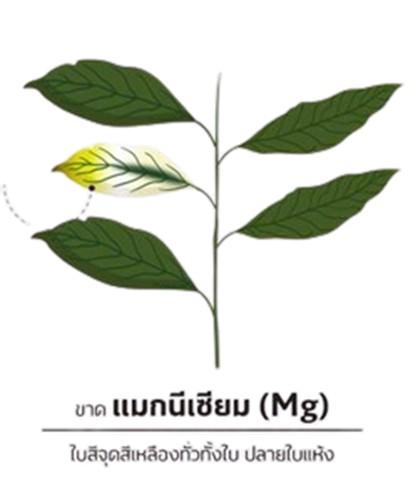
Symptoms of Magnesium Deficiency
Plants lacking magnesium show clear symptoms on the leaves, including yellow spots across the leaf surface and dry leaf tips. The area along the leaf veins remains green, resembling a V-shaped pattern. Symptoms first appear on older leaves, If the magnesium deficiency is severe, it may spread throughout the entire plant.
2. Nitrogen (N)
Nitrogen is an essential nutrient for plant growth. In fruit crops, nitrogen directly affects vegetative growth, flowering, fruit set, fruit development, and fruit quality. Applying nitrogen fertilizer at an appropriate rate is therefore very important.
Nitrogen is a mobile nutrient within plants. Therefore, when actively growing parts of the plant (young leaves and shoots) receive insufficient nitrogen, the nitrogen stored in older leaves is translocated to the younger leaves. This causes the plant to exhibit abnormal symptoms.
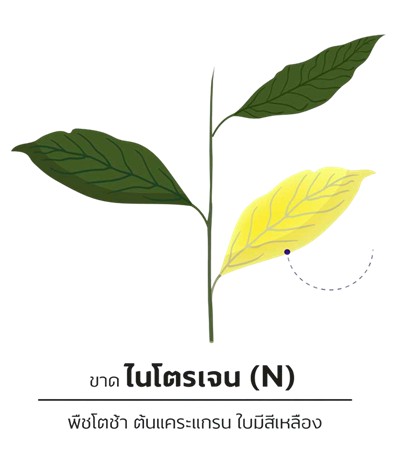
Symptoms of Nitrogen Deficiency
Plants become stunted, Plants become stunted, and older leaves turn light yellow or pale, beginning at the leaf tips and lower leaves. In severe deficiency, the leaves turn brown and the discoloration spreads toward the midrib in a V-shaped pattern. Leaves die and fall prematurely, growth rate slows, new shoots and branches develop slowly, and flowering is greatly reduced.